Aquifer Water Quality
Aquifer Water Quality
Texas Groundwater Intelligence: Understanding Our Aquifers
Groundwater is the lifeblood of Texas, but the data governing it is often buried in technical databases that are difficult to navigate. We have synthesized millions of records from the Texas Water Development Board (TWDB) to provide a clear, regional look at our state’s aquifers.
By grouping complex chemistry into four intuitive categories—Salinity, Age, Health, and Irrigation—we provide an immediate “snapshot” of aquifer health.
How We Group the Data
While the state provides raw numbers, we provide the context. We break the data down by Aquifer, allowing you to see the regional trends that define water quality across Texas.
-
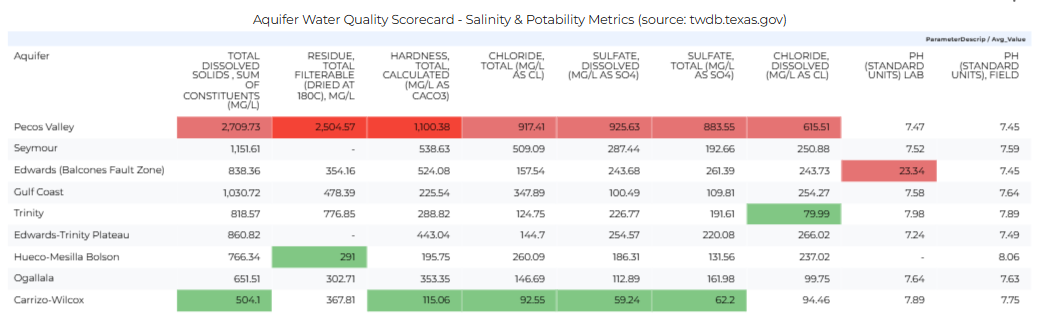
Salinity & Potability: Is the water fresh or brackish? We look at TDS, Chlorides, and Sulfates to determine if the water is palatable or “salty.”
-
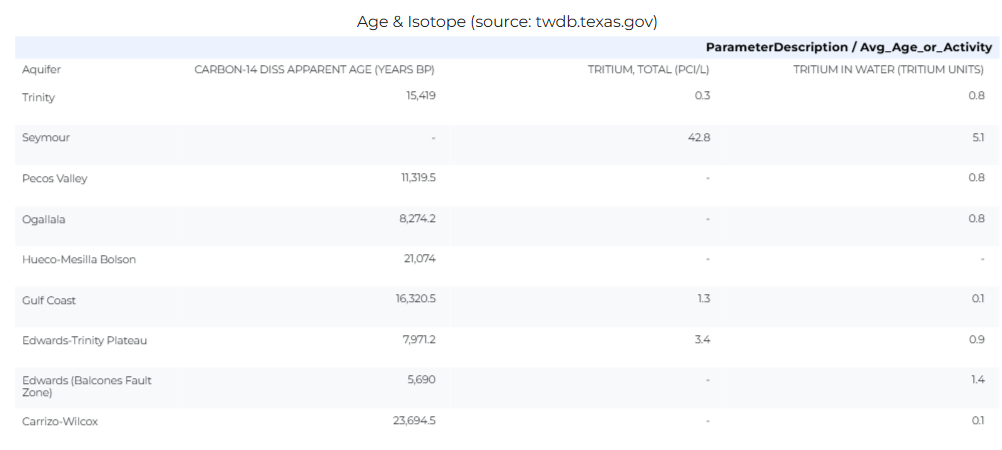
Isotope & Age: How “old” is the water? We use isotopic markers to show if an aquifer is being actively recharged by rain or if we are tapping into “fossil water” that has been underground for millennia.
-
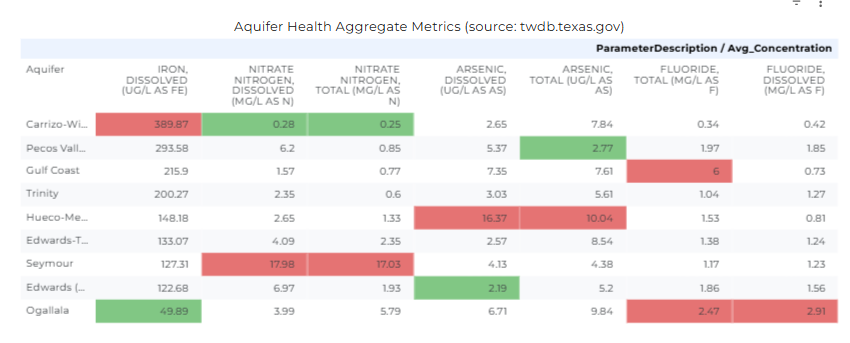
Health & Contamination: Is it safe? We flag markers like Nitrates, Arsenic, and pH levels that exceed EPA safety thresholds.
-
Irrigation Group: Is it good for the land? We calculate the Sodium Adsorption Ratio (SAR) and Conductivity to help producers understand how the water affects soil health.
🌊 Salinity & Potability: “How does it taste?”
This group focuses on the overall mineral content of the water. It tells you if the water is “fresh” or if it’s becoming salty (brackish).
-
Total Dissolved Solids (TDS): Think of this as the “Mineral Sum.” It’s a measure of everything dissolved in the water. Low is fresh; high is salty.
-
Chloride: High levels give water a “salty” taste (like diluted seawater) and can corrode your metal plumbing.
-
Sulfate: Can give water a bitter, medicinal taste and sometimes acts as a natural laxative.
-
Hardness: Measures Calcium and Magnesium. “Hard” water isn’t a health risk, but it stops soap from lathering and leaves white crusty “scale” on your faucets.
- pH Level: Measures how acidic or basic the water is. If it’s too low (acidic), it leaches heavy metals into your drinking water.
⚠️ Health & Contamination
This is the most critical group. We compare the TWDB data against official EPA safety limits to flag chemicals that could be harmful to human health.
-
Nitrate: Often comes from fertilizer or septic systems. High levels are dangerous, especially for infants (“Blue Baby Syndrome”).
-
Arsenic & Fluoride: These are often naturally occurring in Texas rocks. At high levels, they can cause long-term health issues like skin damage or bone problems.
-
Lead & Copper: Usually a sign that the water is “aggressive” (acidic) and is eating away at the home’s pipes
🚜 Irrigation Group: “Is it good for the land?”
Water that is safe for humans to drink isn’t always good for plants. This group helps farmers and gardeners understand how the water affects soil and crops.
-
Sodium Adsorption Ratio (SAR): This measures the “sodium risk.” Too much sodium can ruin soil structure, making it hard for water to soak in and causing it to turn into “bricks” when dry.
-
Specific Conductance: A quick way to measure salinity. If this is too high, it can “burn” the leaves of sensitive plants and stunt their growth

⏳ Isotope & Age: “Where did it come from and how old is it?”
Using specialized “Isotope” data, we can determine the history of the water. This helps us understand if the aquifer is being refilled by recent rain or if we are using “fossil water” that hasn’t seen the surface in 10,000 years.
-
Tritium & Carbon-14: These act like “nature’s clock.” High levels of Tritium usually mean the water entered the ground after the 1950s (Modern Recharge). Low levels suggest ancient water.
-
Stable Isotopes (Oxygen & Hydrogen): These tell us about the climate conditions when the water first soaked into the ground—helping us track where the “recharge” zones are located.
-
Groundwater Age: We use these markers to label water as Modern, Sub-modern, or Ancient.